Description
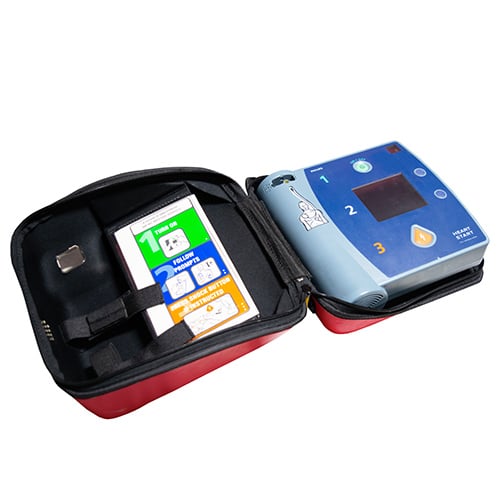
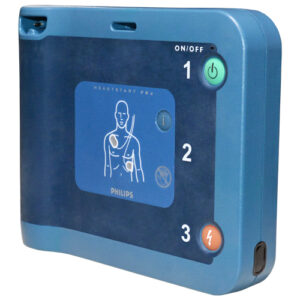
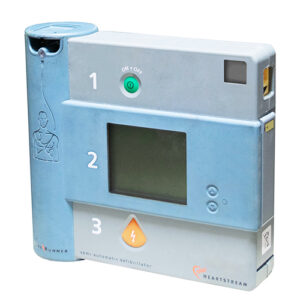
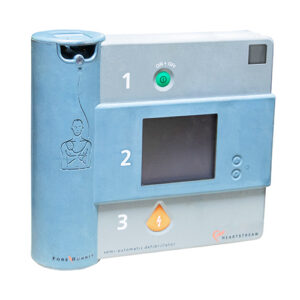
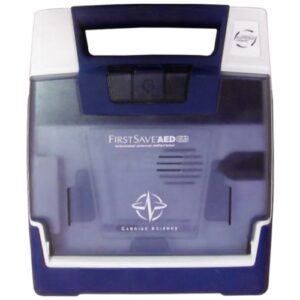
Philips HeartStart FR2+ AED Features:
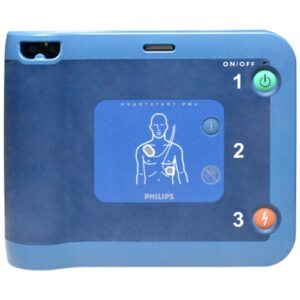
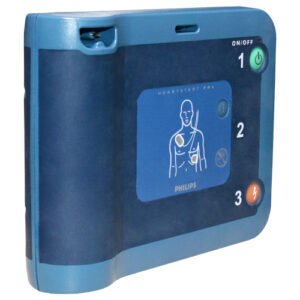
- Portable, battery-powered automated external defibrillator designed for ease of use.
- Rugged design and advanced life-saving technology.
- Simple design with only two buttons: an on/off button and a shock button.
- Display screen to view patient’s ECG, text instructions, and incident information.
- Smart analysis algorithm detects heart rhythm and determines if a shock is needed.
- Smart CPR algorithm determines if CPR should be administered before defibrillation.
- Includes electrode pads for both adult and pediatric patients.
- Offers non-rechargeable long-life lithium battery.
- Optional rechargeable battery available for certain models.
Philips HeartStart FR2+ AED Specifications:
Dimensions:
- Height: 2.6 in. (6.6 cm)
- Width: 8.6 in. (21.8 cm)
- Depth: 8.6 in. (21.8 cm)
- Weight (With standard battery): 4.7 lbs (2.1 kg)
- Weight (With rechargeable battery): 4.5 lbs (2 kg)
Standard Battery:
- 12 VDC 4.2 Ah, lithium manganese dioxide
- Disposable, recyclable, long-life, primary cell
- Capacity: 300 shocks or 12 hours of operating time
- Shelf-Life: 5 Years
Display:
- Type: High-resolution backlight liquid crystal display (LCD)
- Height: 2.3 in. (5.8 cm)
- Width: 2.8 in. (7 cm)
- Display Range: Differential: ±2 mV full scale, nominal
- Sweep Speed: 23 mm/s nominal
- ECG Display: 3-second segments displayed
- Frequency Response (Bandwidth): Nondiagnostic rhythm monitor 1 Hz to 20 Hz (-3 dB), nominal
- Sensitivity: 1.16 cm/mV, nominal
- Heart Rate Displayed: 30 to 300 bpm, updated each analysis period
Defibrillator:
- Waveform: Biphasic truncated exponential
- Energy: Adult pads: 150 J nominal (±15%) into a 50-ohm load. Infant/child pads: 50 J nominal (±15%) into a 50-ohm load
- Charge Control: Controlled by Patient Analysis System for automated operation
- Charge Time: Typically less than 10 seconds
Data Card:
- Capacity: 8 hours of event and ECG data, or 60 minutes with voice recording